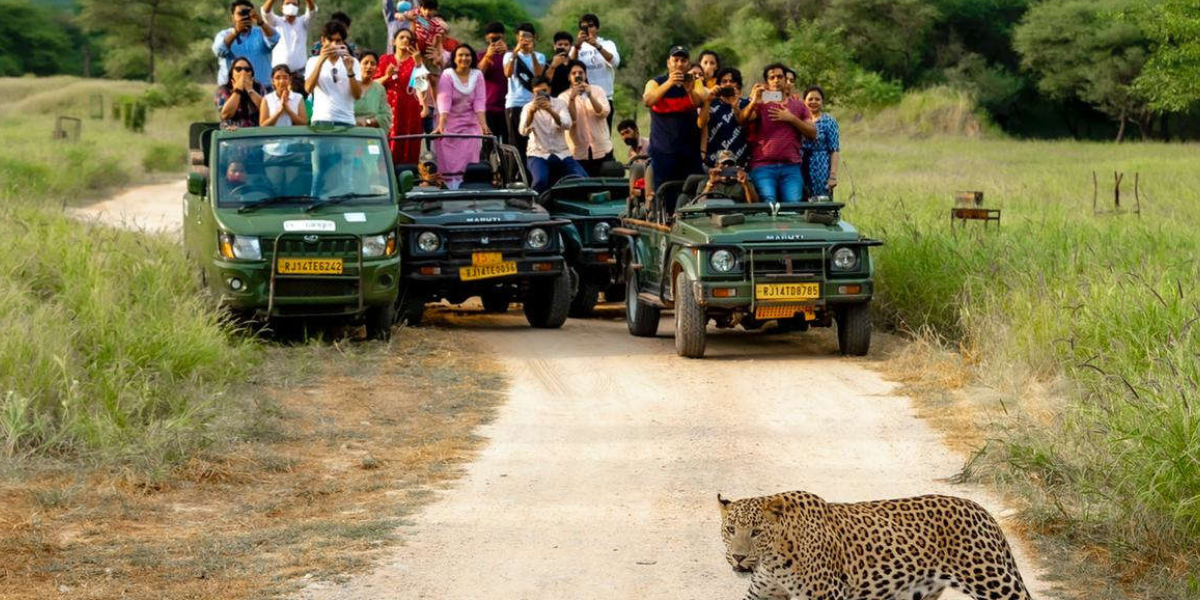
What makes Jhalana great for wildlife photography?
High leopard density
Jhalana's compact 20 sq km packs one of the highest leopard densities in India. That translates directly into more sighting frames per safari — great for beginners practising composition and timing, and for anyone studying leopard behaviour.
Open rocky terrain
Unlike thick jungle reserves, Jhalana has open landscape, dry deciduous forest and rocky outcrops. Clearer sightlines mean cleaner frames — no leaves obscuring your subject.
Close proximity
Leopards here are habituated to vehicles and often pass close to jeeps. You get facial expressions, eye contact, whiskers and fur texture — details you rarely capture in bigger parks.
Light conditions
Both slots produce good light. Morning gives soft, diffused, low-shadow scenes. Evening delivers warm tones with long shadows. Open terrain enhances both.
What you can photograph
Leopards on rocky outcrops
Classic "big cat" frames — leopards resting or scanning from elevated rocks against textured Aravalli backgrounds.
Leopards crossing tracks
Excellent for action shots, walking sequences, and using the trail as a leading line.
Cubs & family moments
Rare but rewarding. Multiple safaris + patience improves your odds.
Other wildlife
- Spotted deer (Chital)
- Blue Bull (Nilgai)
- Golden Jackal
- Indian Peafowl
- Indian Roller
Best time for photography
Morning safari — soft light
Higher wildlife activity, minimal shadows, gentle exposure — ideal for close-up work.
Evening golden hour
Long shadows, warm rock tones, dramatic silhouette opportunities.
Seasonal impact
- Summer (Mar–Jun): thin vegetation, better visibility, earthy dry-tone palette.
- Monsoon (Jul–Sep): lush green, moody skies, harder to spot but atmospheric.
- Winter (Oct–Feb): soft light, comfortable, best mix of sightings and scenic frames.
Best spots for leopard photography
Rocky hills & cave areas
Leopards rest between rock outcrops and cave-like structures — perfect for relaxed poses and textured backdrops.
Waterhole zones
Especially productive in summer. Reflections, symmetry, and multi-species scenes in one frame.
Guide-known territories
Experienced guides know each leopard's usual patches and position the jeep for best angles.
Open track crossings
Leopards use safari tracks as walking routes. Great for movement, eye-level shots and depth-of-field frames.
Camera setup for best results
Ideal lens range: 200–400mm
Long enough for distant animals, flexible for close encounters, and manageable weight.
Shutter speed
1/1000s or faster. Increase for running or actively hunting subjects.
Autofocus
Continuous (AI Servo / AF-C) — locks and tracks moving cats.
Burst mode
Use it. Wildlife happens in fractions of a second; multiple frames give you the one perfect shot.
Positioning inside the jeep
Seat choice matters more than most people realise. Edge seats give you clear left-or-right pathways. Middle seats limit angles. Communicate with your guide and driver — a polite request usually gets the jeep angled to your favour.
Shoot at eye level or slightly below for stronger, more intimate compositions. Stay alert — sightings can last seconds.
Common mistakes to avoid
- Slow reaction time — camera on, lens cap off, before the drive starts.
- Wrong settings — check exposure and focus mode before entering the reserve.
- Talking during a sighting — noise breaks natural behaviour.
- Over-relying on zoom — wider frames often tell better stories.
Can beginners capture good photos?
Yes. Open terrain and frequent sightings make Jhalana one of the few Indian parks where a beginner can realistically go home with strong images. A DSLR or mirrorless gives you far more control than a smartphone — worth the rental if you're serious about the pictures.
One safari vs multiple safaris
More safaris = more chances, different light, different individuals. For serious photography, plan two or three safaris across morning and evening slots.
Ethical wildlife photography
- No flash. Ever.
- Maintain distance — don't pressure the animal.
- No noise, no sudden movement — natural behaviour makes the best photos.
- Follow your guide's instructions.
Final thoughts
Jhalana is one of India's most accessible destinations for wildlife photography — dense leopard population, open terrain, reliable light. It rewards beginners and pros alike. Bring the right lens, respect the wildlife, and you'll leave with frames you're proud of.
Plan a photography safari
Book morning + evening slots for maximum shooting conditions. Callback within 15 minutes.
Book Safari