Photography Experience at Jhalana Leopard Safari: Tips & Best Spots
Ready for a thrilling encounter with Jhalana’s majestic leopards? Plan your perfect safari now. Leave the booking worries to us—we’ll take care of it!
Wildlife photography is often associated with dense forests and unpredictable sightings. But Jhalana Leopard Safari offers a completely different experience with high leopard sightings and open terrain landscapes.
It gives you a rare opportunity to capture leopards in their natural habitat. This makes Jhalana Leopard Safari a truly rewarding destination—and a paradise for wildlife photographers.
Located on the outskirts of Jaipur city, Jahlana is now recognized as one of the best places for leopard sightings in India. It stands out for its accessible and photography-friendly environment with the thrill of photographing some of the country’s most elusive creatures.
It is ideal for both beginners and experienced photographers to observe and capture animals in the wild. So, if you’re looking to elevate your wildlife photography, this guide will help you make the most of your Jhalana Leopard Safari.
What Makes Jhalana Great for Wildlife Photography?
Jhalana offers unique conditions that are highly suitable for wildlife photography, especially for those who want to capture leopards in natural habitats.
High leopard density:
One of the main highlights of Jhalana is its high leopard density in a small forest area. This significantly increases the chances of leopard sightings compared to larger national parks, making it a preferred location for:
- Beginner wildlife photographers
- Those who are practising composition and timing
- Who wants to observe leopard behaviour more closely.
Open Rocky Terrain (Clear Visibility)
Jhalana is very different in its landscape from other dense jungle reserves.
It has:
- Rocky terrains
- Dry deciduous forest
- Open landscape with minimal obstruction
This type of open terrain gives better visibility and clearer frames, important for wildlife photography where the animals are often partially hidden.
Proximity to Animals
Leopard’s proximity to safari vehicles is relatively close in Jhalana. This makes it possible for photographers to often get closer views of animals without disturbing them.
Such conditions help in capturing:
- Better facial expressions and eye contact
- Details like textured fur or whiskers
- Their natural movement and behaviour
Light Conditions (Morning & Evening Safaris)
Lighting plays a crucial role in wildlife photography and Jhalana provides favourable conditions in both the safari slots.
- Morning safaris offer a soft yet diffused lighting with active animal movement.
- Evening safaris often have warm light with longer shadows, which adds to the depth of photos.
The open terrain further enhances the natural lighting and makes it easier to capture well-balanced photographs.
What Can You Photograph in Jhalana?
Jhalana offers a wide range of opportunities for wildlife photography. The primary highlight here is the leopards, often seen moving around open terrains. This makes it easier to capture strong storytelling frames.
Leopards on Rocky Outcrops
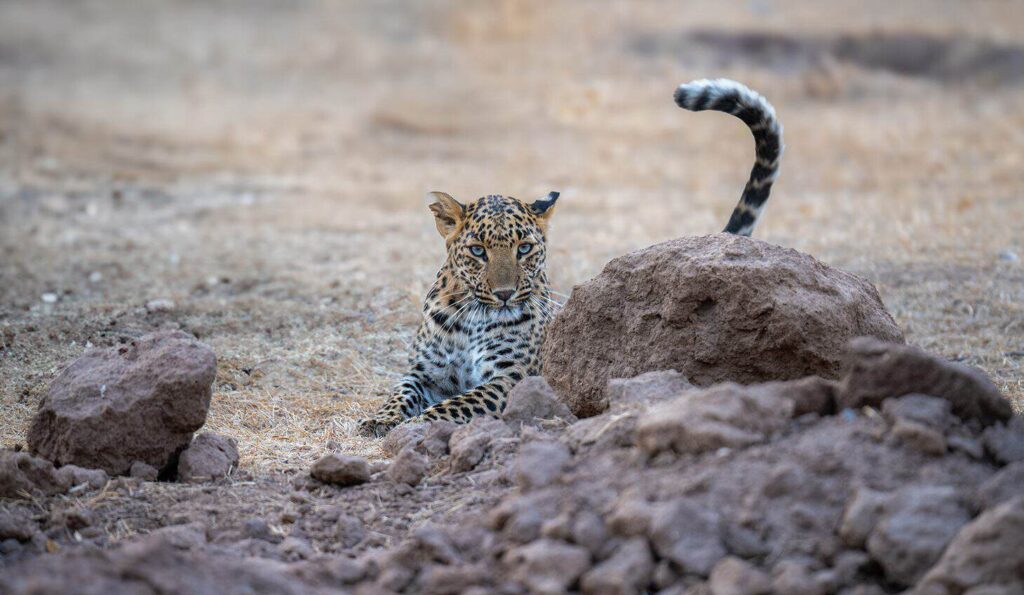
One of the most beautiful shots to capture in Jhalana is leopards resting on rocky hills or scanning their surroundings from up there. These elevated positions allow photographers to capture clean and unobstructed compositions. Resulting in classic “big cat in the wild” frames with a dramatic background with natural texture.
Leopards Crossing Tracks
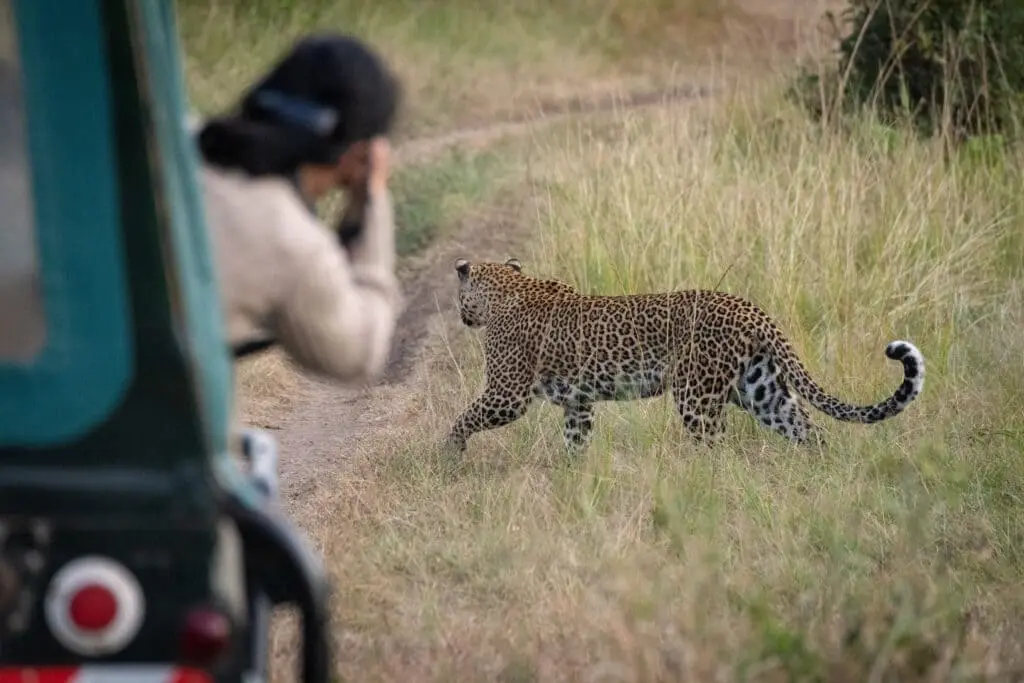
Leopards move freely across the safari tracks as easy pathways which create perfect moments for action shots. It is ideal for capturing a leopard’s natural movement with leading lines, walking sequences or eye-level compositions.
Cubs & Family Movements
One of the rarest but most rewarding moments to capture is the sighting of cubs with their mother. Multiple safaris and enough patience increase the chances of witnessing such moments. Moments like these offer shots like emotional storytelling, playful interactions, and rare behavioural documentation.
Other Wildlife (Deer, Peacocks, Birds)
Apart from leopards, Jhalana supports a variety of wildlife. The commonly spotted species are:
- Spotted deer(Chital)
- Blue Bull(Nilgai)
- Golden Jackal
- Indian peafowl
- Indian Roller
Best Time for Photography in Jhalana
In wildlife photography, timing matters a lot. Jhalana Leopard Safari Park offers excellent conditions throughout the day. One should understand the seasonal changes and light conditions to capture strong images.
Morning Safari Lighting (Soft Light Advantage)
During early hours:
- Chances of wildlife activity are higher than usual
- Minimal shadows
- Light is gentle
This helps in capturing sharp images, especially for close-up shots.
Evening Golden Hour Shots
Golden hour’s glow adds warmth and depth to your photographs.
One can expect:
- Long shadows enhance composition.
- Dramatic Lighting for silhouette shots
- Warm tones on rocky landscapes
Seasonal Impact on Visibility & Colors
When you visit Jhalana, seasons play a key role in how the place feels in photos and how easy it is to see wildlife.
Summer (March-June)
Meagre vegetation boosts visibility, thus improving your chances of spotting leopards. Colours tend to look drier, earthier, and more rugged.
Monsoon (July to September)
The place turns lush and green, and it can make sightings harder. Photos often lean more toward mood, drama, and atmosphere than clear wildlife views.
Winter (October-February)
The weather is comfortable with moderate greenery, and light is usually soft, which makes it the best time if you want a mix of sightings and scenic frames.
Best Spots for Leopard Photography in Jhalana
The Jhalana Leopard Safari Park requires knowledge of locations to help photographers achieve better results. The different safari routes provide places which bring better chances to observe wildlife.
Rocky Hills and Cave Areas
Leopards in Jhalana prefer to rest and hide between rocky outcrops and cave-like structures.
These spots are ideal for:
- Capturing leopards in relaxed, natural poses
- Framing subjects against textured rocky backdrops
- Elevated compositions with clear visibility
Waterhole Zones
Animals become active in areas near water sources during hot weather.
Here, you may capture:
- Leopards that approach or rest beside water
- Reflections and symmetrical compositions
- Other wildlife interactions in a single frame
Leopard Territories Which Require Guide Assistance
The experienced guides know about the active leopard areas that exist throughout the park.
- The guides assist with trackable recent animal movements.
- The vehicle positioning method enables various viewing opportunities.
- The guide assists with their knowledge, which helps you encounter more important wildlife.
Open Track Crossings
Leopards use safari tracks as their main walking routes, which makes these areas great for hunting.
The moments provide excellent opportunities for:
- Action Shots of movement
- Eye-level compositions
- Using the track as a leading line for depth
Camera Setup for Best Results
The right camera setup allows you to achieve better wildlife photography results. This makes your images appear sharp and well-exposed in Jhalana.
Ideal Lens Range(200-400mm)
The 200-400mm lens range functions best in Jhalana because wildlife appears at closer distances.
The product provides:
- Users can capture both nearby and distant subjects.
- Users can create accurate visual frames without using maximum zoom.
- Users can control the composition.
Shutter Speed for Wildlife Movement
Leopards require fast shutter speeds because they run at high speeds. For moving subjects, use shutter speeds which start at 1/1000s or faster. The shutter speed needs to increase beyond 1/1000s for capturing subjects who run or engage in active movement.
This technique enables photographers to capture moving subjects, resulting in clear images without any blurriness.
Autofocus Settings
The correct autofocus mode lets you capture all important moments. For best results, use the continuous autofocus with AI Servo or AF-C mode. This system enables seamless tracking of moving subjects and maintains a clear focus on your subject while they continue to move.
Burst Mode Usage
Wildlife behaviour is unpredictable, and unexpected moments happen quickly. So, the photographer should use both the burst mode and the continuous shooting mode to capture multiple frames, which allows them to get perfect shots.
Positioning Inside the Jeep (Underrated Factor)
The safari vehicle seat position can affect your photography results, while gear selection also matters.
Since different seats provide different advantages for the passengers. Edge seats create an open pathway which allows passengers to see everything without any visual blocks. On the other hand, middle seats may limit your shooting angle as they direct the viewing area, which controls how much of your subject appears in the frame.
Another important thing is the angle you choose for shooting because the strength of your composition depends on it. Images become more powerful when photographers choose to shoot from eye level or slightly below.
A good position enables you to create images which appear authentic. Your guide and driver also play a key role in your photography experience. Communicate your need for positioning politely and the driver will make vehicle angle changes when required. The quality of shots improves significantly when the best photography conditions are created.
And, lastly, through staying alert, as wildlife sightings can happen suddenly and can last only for a few seconds.
Common Photography Mistakes to Avoid
Even in a photography-friendly destination like Jhalana, small mistakes can cost you great shots. And knowing some of these mistakes to avoid can improve your photography game:
Slow reaction time
Moments occur suddenly in the wild with unpredictable animal behaviour. You can easily miss a good shot when you take too long to lift your camera or change the settings.
Wrong camera settings
When you select incorrect exposure settings, focus mode or shutter speed, blurred images can occur. Your settings should remain active based on current lighting and movement conditions.
Talking/noise during sighting
Wildlife behaviour can become less natural when humans produce unnecessary noises. Staying quiet helps in observing and capturing more authentic moments.
Over-reliance on Zoom
Relying excessively on zoom will reduce both your ability to compose shots and the quality of your photographs. Wider frames that include natural surroundings produce better storytelling results.
Can Beginners Capture Good Photos in Jhalana?
Yes, Jhalana is one of the few places where beginners can realistically capture good wildlife photographs.
Jhalana has the advantage of easy visibility due to open terrains. Photographers find it easy to spot animals in open terrain because it makes animal tracking easier than in dense forests.
Moreover, beginning photographers can practice their skills through multiple opportunities to see wildlife up close, including learning to frame shots and focus their cameras.
While smartphones enable visitors to record basic wildlife highlights, their abilities do face multiple limitations:
- Zoom capability
- Low-light performance
- Motion capture
Therefore, wildlife photography requires a DSLR or mirrorless camera to provide superior control and image quality over other cameras.
One Safari vs Multiple Safaris for Photography
Multiple safaris can naturally increase your chances of leopard sightings and better photographic opportunities. Because each safari offers a different lighting experience, morning and evening conditions can completely change the look and feel of your photos.
If your main goal is serious wildlife photography:
- Plan multiple safaris
- Experiment with angles and settings
- Focus on quality rather than just sightings
These tips can help you build a stronger and more diverse portfolio.
Ethical Wildlife Photography Guidelines
Responsible photography is important while capturing animals in their natural habitat.
- No flash:
Avoid using any flashes, as they may disturb or stress animals, especially predators like leopards. - Maintain distance:
Respect the animal’s space and avoid pushing them for close encounters. - No disturbance to animals:
Do not make loud sounds or sudden movements to attract animal attention. Their natural behaviour always gives the best photographs. - Follow the guide instructions:
Always listen to your guides, as they understand animal behaviour and park rules better. Following their instructions ensures both safety and ethical practices.
Final Thoughts – Is Jhalana Worth It for Photography?
Jhalana Leopard Safari stands out as one of the most accessible destinations for wildlife photography. Its high leopard sightings, open terrain and favorable lighting conditions make it extremely valuable for those wanting to capture strong wildlife images without the unpredictability of larger and dense forests.
It is best suited for:
- Beginners who are just starting wildlife photography
- Wildlife enthusiasts who want consistent leopard sightings
- Photographers aiming to improve their skills in composition and timing
So, if your goal is to experience and capture leopards in the wild with better chances. Jhalana offers clearer frames that are definitely worth considering.
Add Your Heading Text Here
Jhalana Leopard Safari Morning vs Evening | Jhalana Leopard Safari vs Ranthambore | Best Time to Visit Jhalana Leopard Safari | Camera & Clothing Tips for Jhalana | Can You See Leopards Easily in Jhalana? | Chances of Seeing a Leopard in Jhalana Safari | Is Jhalana Leopard Safari Safe? | Is Jhalana Leopard Safari Worth It in Jaipur?